

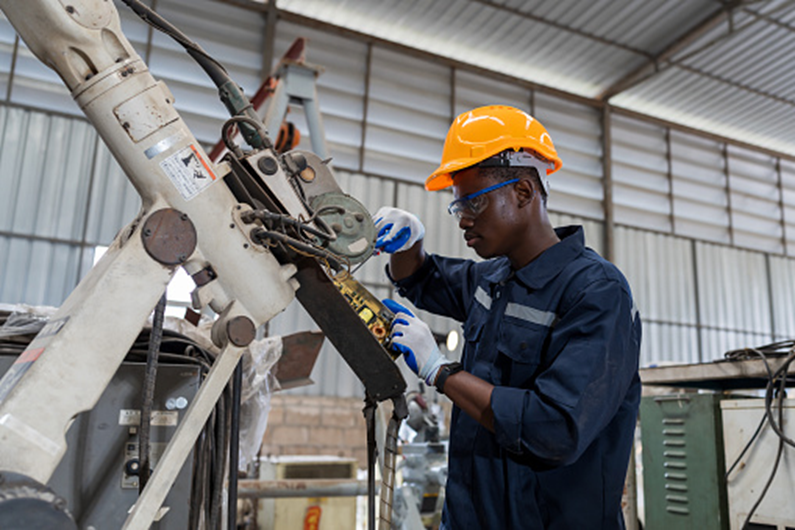
The continent’s development challenge is not simply to grow faster, but to capture more value from its resources, create productive jobs and build industries capable of competing globally.
By Kundai Gorejena
Africa accounts for roughly 17 per cent of the world’s population, yet its contribution to global manufacturing remains disproportionately small. The continent exports cocoa beans and imports chocolate, ships raw cotton abroad and buys back finished garments. It extracts minerals essential to modern technology but often captures only a fraction of the value generated when those minerals are processed into industrial products.
The problem is not a shortage of resources. It is the limited capacity to transform them into higher-value goods.
Economic development is about more than rising gross domestic product. It requires changing what an economy produces, how efficiently it produces it, the quality of employment it creates and how widely prosperity is shared.
Industrialisation remains central to that transformation. Without it, Africa risks remaining trapped in a model where raw materials leave its shores, finished products return at a premium, and many of the associated jobs, skills and profits are created elsewhere.
Why the factory floor matters
The experiences of Britain, South Korea and China offer an important lesson. Although their development paths differed, industrial expansion helped these economies move workers into more productive activities, develop technical capabilities and establish competitive industries.
Manufacturing raises productivity through machinery, economies of scale, technological adoption and learning-by-doing. As firms improve their processes and workers acquire specialised skills, they produce more with the same resources. Sustained productivity growth creates the foundation for higher wages, stronger businesses and improved living standards.
Factories can also help address Africa’s employment challenge. Millions of young Africans enter the labour market each year, yet many economies struggle to create sufficient formal, productive jobs. Informal trading and low-productivity services provide livelihoods, but cannot alone deliver the scale of economic transformation required.
Manufacturing offers employment opportunities across different education and skill levels, from food processing and textiles to pharmaceuticals and engineering. It also creates demand for transport, packaging, banking, insurance and professional services, spreading income beyond factory gates.
Industrialisation, therefore, is not simply about building factories. It is about developing an interconnected productive economy.
Why Africa is falling behind
Several African economies have struggled to expand manufacturing sufficiently to transform their economic structures. In some countries, manufacturing has stagnated or declined as a share of economic output, while employment has shifted towards informal services before industrial capacity has matured.
This premature deindustrialisation limits opportunities for countries with low incomes, rapidly growing populations and substantial unmet demand for goods and infrastructure.
The obstacles are familiar. Unreliable electricity increases production costs and disrupts operations, while dependence on generators undermines competitiveness. Expensive finance makes it difficult for manufacturers to invest in machinery, technology and expansion, particularly when industrial projects require substantial upfront capital and time to generate returns.
Inadequate roads, inefficient ports and costly logistics further weaken competitiveness. Even products manufactured efficiently can lose their price advantage when moving them to market is expensive.
Market fragmentation compounds these challenges. National borders, inconsistent standards and cumbersome customs procedures prevent firms from achieving the production volumes needed to compete internationally. Meanwhile, unpredictable tax, trade and investment policies discourage long-term commitments.
These constraints reinforce one another. Small markets discourage investment, weak investment limits productivity, and low productivity undermines competitiveness. Breaking this cycle requires a coordinated industrial strategy rather than isolated interventions.
Turning resources into an industrial advantage
The opportunity remains substantial. Ethiopia has attracted garment manufacturers through its industrial parks, while Morocco has developed automotive production and export capabilities. Rwanda has sought to attract investors through improvements in its business environment.
These experiences offer lessons, not universal templates. Industrial parks cannot succeed on incentives alone. The objective must be to develop local suppliers, transfer skills, strengthen technical capabilities and retain more economic value within domestic economies.
The African Continental Free Trade Area (AfCFTA) offers another opportunity. By creating a framework for a more integrated continental market, it gives manufacturers the prospect of reaching customers beyond national borders. Firms that cannot achieve sufficient scale domestically may become viable when serving several African markets.
Realising this potential requires more than signing agreements. Governments must reduce non-tariff barriers, improve customs efficiency, harmonise product standards and address infrastructure gaps that make cross-border trade expensive.
The global transition towards cleaner energy presents an additional opening. Africa possesses significant deposits of minerals used in batteries, electric vehicles and renewable-energy technologies. Exporting these resources without developing domestic processing risks reproducing the extractive model in a new market.
Not every country needs to manufacture finished batteries or electric vehicles. However, countries can pursue commercially viable stages of the value chain, including mineral processing, component production and specialised technical services.
From ambition to execution
A credible industrial agenda must begin with reliable, affordable electricity. Power infrastructure directly determines factory costs, output and competitiveness.
Governments must also make local value addition commercially viable. Agricultural commodities can supply competitive food-processing industries, while minerals and forestry resources can support downstream production where domestic processing makes economic sense. Local production targets must be matched by investment in technology, skills and infrastructure.
Special economic zones can concentrate infrastructure and investment, but their success should be measured by productive enterprises, exports, employment, technology transfer and links with local suppliers, rather than tax concessions alone.
Finance is equally important. Development finance institutions, commercial banks and institutional investors need mechanisms to support viable industrial projects with appropriate loan maturities and manageable risks. Public support should help overcome genuine market failures, not sustain permanently uncompetitive businesses.
Skills development must also reflect industrial needs. Technical institutions should work with employers to train engineers, technicians, electricians and other workers required by expanding industries. Research institutions can help firms adopt technology, improve product quality and develop new products.
Above all, industrial policy requires consistency. Investors need predictable rules, while governments must evaluate interventions honestly and withdraw support when they fail to deliver results.
The choice that will define Africa’s future
Industrialisation will not eliminate poverty overnight, and manufacturing is not the only source of productivity growth. Modern services, digital technologies and competitive agriculture all have essential roles to play. However, without a stronger industrial base, many African economies will struggle to create enough productive jobs, diversify exports and capture more value from their resources.
The ingredients for change are present: a young workforce, expanding consumer markets, abundant natural resources and a continental trade framework with considerable potential.
What remains is the ability to turn these advantages into competitive production.
Africa does not need more declarations of industrial ambition. It needs reliable power, affordable finance, efficient logistics, skilled workers and predictable policies that allow productive firms to grow.
The measure of progress should not be how many factories are announced, but how many become viable businesses that produce competitively, employ people and create lasting economic value.
The factory floor is not the entirety of Africa’s development story, but it will be one of the places where that story is decided.