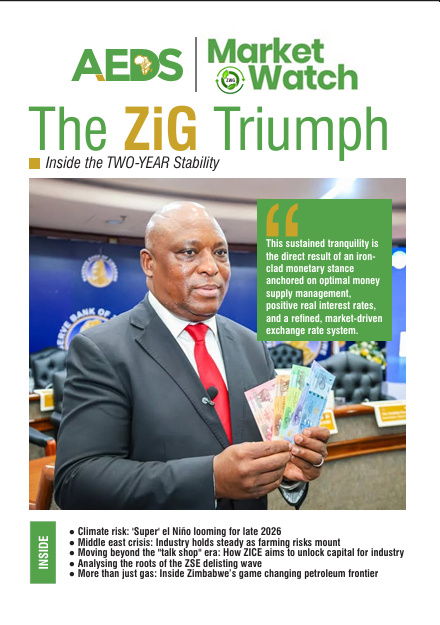
Zimbabwe targets climate resilience, farm-level processing
Zimbabwe is targeting climate resilience as a primary anchor for its economic transformation and food security agenda amid mounting climate threats and global economic pressures, Vice President Dr Constantino Chiwenga has said.
Addressing delegates at the 14th Annual National Agribusiness Conference in Harare, Dr Chiwenga said national planning for the upcoming 2026/27 summer cropping season is being organised around the threat of a severe global climate anomaly, compounding existing geopolitical pressures.
The conference, convened under the theme “Agricultural Productivity as a Catalyst for Agribusiness Growth and Food Security,” focused on climate risk management, structural value-chain integration, and economic adaptation.
Central to the Vice President’s address was the convergence of severe external risks threatening Southern Africa’s food balance.
Beyond ongoing geopolitical tensions that have elevated international fuel and fertiliser prices while disrupting regional supply chains, global climate models forecast a Super El Niño.
The weather pattern is expected to bring severe heat and extended dry spells to Southern Africa, raising the threat of widespread drought.
“The outlook for the 2026/27 summer season represents a critical stress test for Zimbabwe’s agricultural resilience,” Vice President Dr Chiwenga said.
“Our planning is driven by the convergence of two major threats – the current geopolitical tensions elevating fuel and fertiliser prices and disrupting their supply, and another of a forecasted Super El Niño.”
Highlighting scientific warnings on the severity of the pattern, Dr Chiwenga noted that researchers have referred to the upcoming event as a “Godzilla El Niño” due to its unusual intensity.
While the global climate pattern is projected to trigger heavy flooding and storms in parts of the Western Hemisphere, it threatens Southern Africa with extreme heat, prolonged dry spells, and widespread drought conditions.
“The anticipated impacts include disruptions to food and water supplies and the likelihood of severe drought conditions, with no country able to assist another or acquire shortfalls from external supplementation,” Dr Chiwenga said, urging an immediate shift from reactive drought response to proactive structural adaptation.
“Therefore, it is imperative to adopt proactive measures in water conservation and food security planning.”
To mitigate these severe hydrological and production risks, the government outlined a multi-pronged intervention strategy.
Central measures include the rapid rehabilitation of national borehole networks, accelerated expansion of irrigation infrastructure, and an enforced crop diversification shift toward drought-tolerant, climate-resilient commodities including sorghum, millet, and sunflower.
Zimbabwe’s climate response is backed by a financial and structural framework designed to insulate domestic value chains.
Under the strategy, the government is mobilising an Integrated Financing Architecture combining Treasury allocations, private sector capital, and targeted credit through the National Enhanced Agricultural Productivity Scheme.
Additional operational priorities include strengthening the Strategic Grain Reserve, implementing early warning and early-action systems, ensuring input affordability, and executing livestock drought mitigation protocols to prevent herd depletion.
The climate emergency interventions align directly with the targets set under the National Development Strategy 2, alongside the Agriculture, Food Systems and Rural Transformation Strategy 2.
Beyond immediate climate shielding, Chiwenga noted that Zimbabwe must execute a structural transition away from raw, primary production toward a commercially integrated, value-added model.
“We must move from a predominantly production-focused agricultural sector to a highly commercially integrated and value-added across the entire agricultural economy,” Dr Chiwenga said.
“In light of these considerations, we must begin to adopt an agro-business approach anchored in the ‘Farm to Fork’ concept, often referred to as ‘Farm to Table Policy.”
This policy framework targets localised processing at the farm level, supported by centralised aggregation for domestic industrial supply and regional export markets.
Dr Chiwenga called on smallholder and commercial farmers to form farmer-owned processing cooperatives and directly engage in value addition at the source to eliminate intermediary transaction costs.
To facilitate this integration, the government plans to roll out specialised Agro-Industrial Parks aimed at bridging the gap between primary producers, commercial processors, and institutional financiers.
Highlighting demographic imperatives, Dr Chiwenga added that driving long-term agricultural modernisation requires targeted financial and technical inclusion for women and youth, positioning them as primary drivers of technology adoption, commercial farming, and rural industrialisation.
Speaking at the same event, Minister of Agriculture, Mechanisation and Water Resources Development Dr Anxious Masuka said the southern African nation must leverage its agricultural resources, strategic location and human capital to transition into a regional agro-industrial hub.
“Zimbabwe clearly must move and transition from being a breadbasket to becoming the agro-industrial hub, serving the region, taking advantage of the African Continental Free Trade Area, but going beyond so that we can begin to create the Zimbabwe we want,” he said.
He added that the country’s agricultural transformation should extend beyond increasing primary production to developing competitive value chains capable of supplying regional and international markets with processed and value-added products.
Agriculture remains the backbone of Zimbabwe’s economy, supplying over 60% of the raw materials required by the domestic manufacturing sector and sustaining the livelihoods of more than 60% of the national population.
Beyond its critical role in rural livelihoods, the sector contributes approximately 12 to 15% to national GDP and serves as the country’s second-largest generator of foreign exchange earnings, primarily driven by tobacco, horticulture, and cotton exports.
This will close in 10 seconds