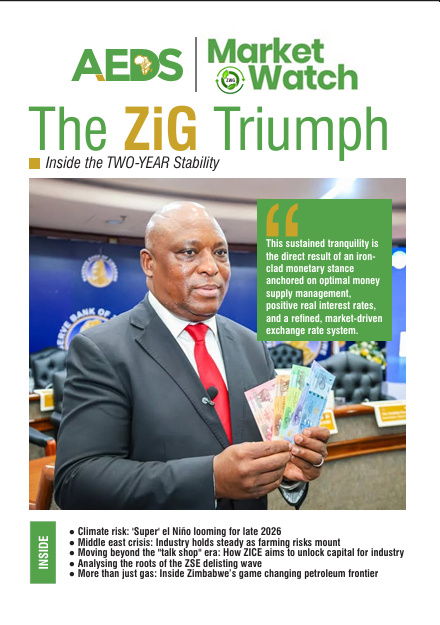
The dialogue was hosted by AEDS under the theme: Geopolitical Risks: implication for Zimbabwe and Policy Options. The dialogue provided a review of the state of the economy in the first quarter and the 2026 economic outlook. In addition, the dialogue also provided robust discussions on the US-Israel war with Iran and its impact on the global economy and Zimbabwe with emphasis placed on production and consumption, the prices of goods and services, and fertilizer and fuel prices at global, continental, and regional levels.
The Honourable Minister of Industry and Commerce was the guest of honour. The event also received presentations from the Reserve Bank of Zimbabwe, the Grain Millers Association of Zimbabwe, the Ministry of Lands, Agriculture, Fisheries, Water and Rural Development, and AEDS. The dialogue was attended more than 100 people from the business community, government, academia, media houses and think tanks. The research output was disseminated through a presentation of the Second Edition of the Zimbabwe Economic Pulse (First Quarter 2026 Review), focusing on the real-time evaluation of Zimbabwe’s economic trajectory and highlighting a broadly positive yet fragile outlook anchored on projected economic growth of 5%, driven by strong agricultural recovery, firm gold prices, and improved macroeconomic stability.
The report underscores significant gains in inflation reduction to single-digit levels, supported by tight monetary policy, exchange rate stability, and disciplined liquidity management, alongside improved fiscal consolidation despite persistent structural pressures such as debt servicing and expenditure rigidities. The report further analyses sectoral performance, noting resilience in mining and agriculture, mixed outcomes in manufacturing due to high production costs and power shortages, and a gradual recovery in tourism. Importantly, it identifies key downside risks including geopolitical tensions (notably the US–Iran conflict), rising oil prices, climate shocks, energy constraints, and entrenched dollarization. The report argues that sustaining stability will require continued fiscal and monetary discipline, structural reforms, export diversification, and strengthened confidence in the local currency.