
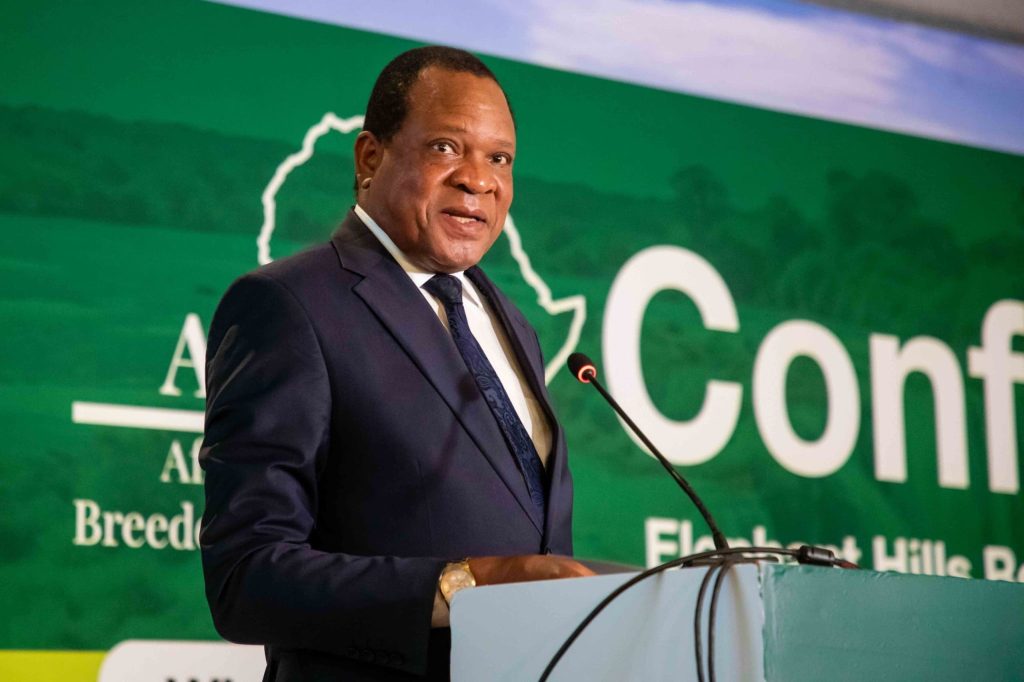
Minister of Agriculture, Mechanisation and Water Resources Development Dr Anxious Masuka says agriculture must serve as the primary catalyst for industrialisation and broader macroeconomic expansion.
Speaking during a high-level ministerial panel at the recent Zimbabwe Industrialisation Conference and Expo 2026, Dr Masuka underscored that sustainable economic growth remains intrinsically tied to performance in the primary sector.
“Agriculture is a causal co-factor and multiplier effect on the rest of the economy. Other than providing the raw materials and fuel that keep us healthy, a healthy nation will be more productive. If we get agriculture right, we are likely to get every other sector and value chain right,” Dr Masuka said.
The government is prioritising structural reforms designed to expand the agricultural sector’s economic footprint under the second phase of the Agriculture and Food Systems Transformation Strategy.
“Within the Agriculture Food Systems and Rural Transformation Strategy 2026-2030, we want to create a US$15.8 billion sector from the current US$13 billion or so, and we can only do this if we work together,” he said.
Dr Masuka noted that recurrent climate-induced disruptions pose the single greatest threat to sector productivity and national food security, necessitating deliberate structural adaptations across all farming scales.
“Climate change is the biggest threat that we see in agriculture, and our adaptive and mitigation response is to have a climate-smart agriculture sector sufficiently resilient to withstand the episodic shocks that are caused by droughts. Droughts now visit us every three to four years, more often than in the past,” Dr Masuka said.
With meteorological assessments pointing toward heightened climate risks, the government has instituted targeted interventions across six foundational pillars to insulate domestic production.
“For this season, 2026/2027, there is a 100% probability that we will have an El Niño, the magnitude of which we do not know at this stage. But if we plan for the worst and hope for the best, government has come up with a very robust plan anchored on six pillars,” Dr Masuka said.
He outlined these interventions as an enhanced strategic grain reserve, climate-smart agricultural production, livestock drought mitigation, a revamped financing architecture for agriculture, an updated import management regime, and enhanced early warning coordination and capacity building.
To achieve these targets, he said the agriculture ministry is implementing five overarching guiding principles across the sector.
“The first one is that agriculture must be a business everywhere, irrespective of scale. The second one is climate-smart agriculture at the household level through the sustainable intensive conservation agriculture model, Pfumvudza/Intwasa, and at the national level through increased irrigation development.
“The third is value addition. The fourth is a systems or ecosystem approach. Agriculture alone is not the enterprise on a farm, there are so many other enablers, and in the ministry, we track about 22 enablers including power, finance, logistics, land, and much more,” Dr Masuka said.
Highlighting the final principle, Dr Masuka stated that the ultimate policy objective extends beyond traditional primary output toward complete industrial integration.
“The fifth and perhaps most important principle embedded in the strategy is that Zimbabwe does not yearn to become a breadbasket of anyone anymore. Zimbabwe must emerge by 2030 as an agro-industrial hub,” Dr Masuka said.
He said Zimbabwe is strategically positioned to serve as a thriving agro-industrial hub due to its central location in Southern Africa, strong logistics network, favourable climate, fertile soils, and exceptional talent.
The Minister said the core advantages form the foundation of the country’s push toward agro-industrialisation, which is key to achieving its vision of becoming an upper-middle-income nation.
The policy imperatives come ahead of the National Agriculture Conference and Expo, scheduled for September 24–25, 2026, at the Diamond Conference Centre at the University of Zimbabwe.
Stakeholders will gather to refine strategies aimed at curbing the nation’s agricultural import bill and strengthening regional value chains.