
The Chamber of Mines of Zimbabwe says the mining sector requires approximately US$2 billion in capital for beneficiation this year, with 70% of the funding targeted at the platinum group metals (PGMs) and lithium industries.
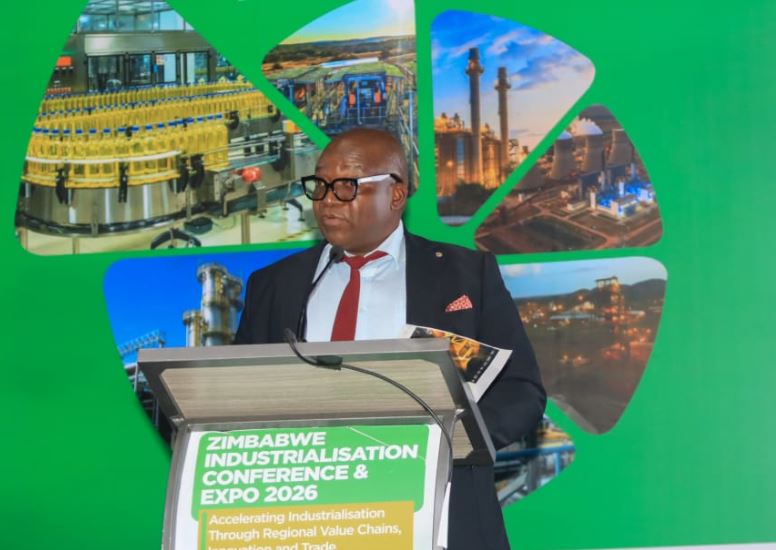
Speaking at the Zimbabwe Industrialisation Conference & Expo 2026, Chamber of Mines Chief Executive Officer Dr Isaac Kwesu said while Zimbabwe has made operational strides, manufacturing higher-value finished goods requires addressing fundamental cost and operational barriers.
“In terms of the funding gap, in 2026 alone, the mining industry requires approximately US$2 billion for beneficiation, with 70% required in the PGMs and lithium industries. There is a need for a competitive operating environment that unlocks sufficient capital to meet requirements for setting up and running beneficiation facilities,” he told delegates at the conference.
He said fiscal measures, including export penalties, continue to constrain investment in mineral beneficiation.
“There is a need to establish special economic zones for beneficiation facilities, supported by competitive fiscal incentives and enabling infrastructure,” he said.
Dr Kwesu highlighted that major operational bottlenecks are currently undermining local industrialisation, including power supply constraints.
“The power supply situation in the country has remained predominantly fragile. Mining companies are experiencing unscheduled outages resulting in production stoppages and output losses,” he said.
“The industry is currently consuming around 1,000 MW of power. However, with ongoing expansion activities and new beneficiation facilities, the energy demand is set to surge to more than 1,500 MW in the next 12 months.”
He said additional challenges include inadequate rail and water infrastructure, high production costs, capital constraints, and a suboptimal fiscal framework burdened by export penalties.
Zimbabwe is currently drafting an integrated Beneficiation Strategy intended to align mineral processing directly with broad industrialisation goals.
Dr Kwesu said establishing a competitive operating environment remains a necessary precursor to attracting the capital needed to convert raw natural resources into lasting national prosperity.
He said mineral beneficiation is crucial to expanding the mining sector’s role in national development, value addition, and job creation.
Dr Kwesu said Zimbabwe’s industrialisation strategy should move beyond producing refined minerals to manufacturing finished products.
“Zimbabwe’s rich mineral endowment can be strategically leveraged to advance the country’s socio-economic development agenda. Mineral beneficiation serves as a catalyst for maximising the sector’s contribution to economic growth, industrialisation, value addition, employment creation, and national development,” he said.
He noted that the national strategy must pivot from relying on static comparative advantages to deliberately cultivating competitive advantages.
“Mining and manufacturing beneficiation are integrated critical components of the growth, development and transformation of Zimbabwe’s economy,” he said.
He called for a decisive shift in national policy to transition the country’s industrial sector, warning that possessing vast mineral reserves is no longer sufficient to secure economic growth.
“Mining beneficiation should not be viewed as the end goal. It should serve as the bridge to manufacturing beneficiation,” Dr Kwesu said.
“The availability of mineral resources does not necessarily provide a competitive advantage. There is need to address the competitive advantage issues to sustain beneficiation. The country therefore needs to develop an integrated policy framework to incorporate the mineral beneficiation and mineral value chains into the broader manufacturing and industrialisation framework,” he added.
Despite highlighting systemic barriers, Dr Kwesu pointed to key operational strides already made on the local beneficiation agenda.
He said the platinum sector now processes 100% of its concentrates in-country, while Zimplats is refurbishing its base metal refinery.
In the lithium sub-sector, he said producers are advancing under a government roadmap to process lithium sulphate locally by 2027, with Prospect Lithium already exporting sulphate.
He added that the Dinson Iron and Steel plant in Manhize is already producing over 600,000 tonnes of steel products annually toward a 1.2 million-tonne design capacity.
Dr Kwesu highlighted global market dynamics to demonstrate that primary mineral extraction does not automatically yield downstream industrial processing.
Pointing to international gap analyses across diamonds, gold, platinum group metals (PGMs), and steel, he noted that major beneficiation centres such as India, China, Japan, Europe, and Dubai capture the highest economic value despite producing minimal or no raw minerals themselves.
To bridge this gap, Dr Kwesu argued that local policies must look beyond primary refining. Zimbabwe’s mining sector is built on a rich geological endowment of over 60 commercially proven minerals, dominated by gold, PGMs, lithium, chrome, and iron ore.
The industry serves as the backbone of the national economy, contributing approximately 12% to GDP and generating more than 75% of Zimbabwe’s total export earnings.
While historically focused on raw extraction, the sector is increasingly pivoting toward domestic beneficiation and value addition to drive full-scale industrialisation and job creation.