STAFF WRITER
The Reserve Bank of Zimbabwe (RBZ) Governor Dr John Mushayavanhu will headline the 2025 Economic Review and 2026 Outlook breakfast meeting in the capital Harare NEXT Thursday.
The event is organised by w the African Economic Development Strategies (AEDS) in partnership with Business Times, a market leader in business, financial and economic reportage.
It will centre on the launch of the flagship Zimbabwe Economic Pulse (ZEP) report, which is expected to provide hard facts, granular information and forecasts on the country’s economic prospects grounded in rigorous economic inquiry and analysis.
Dr Mushayavanhu , who will be the Guest of Honour, is expected to deliver critical insights ahead of the 2025 Monetary Policy Statement , expected to be delivered in February. His address will also cover successes and challenges threatening the stability and the policy outlook for 2026.
AEDS executive director Professor Gift Mugano will be the main speaker.
His report will provides a deep dive into the state of the economy, providing rigorous analysis and forecasts.
It will cover granular details across several critical areas, including the real sector, fiscal and monetary developments, exchange rate developments, financial markets development, external sector and public debt.
Adding to the depth of discussion , the meeting will feature a panel of esteemed experts, including Dr Nigel Chanakira, the Executive Chairman of Power Tank, Latifa Kassim, the Head of Treasury, Marketing and Corporate Affairs at Nedbank Zimbabwe, Brains Muchemwa , the Managing Director of Oxlink Capital and Pretty Nyati, Chief economist at AEDS.
In 2021, Durban University of Technology through its newly established Centre for African Governance and Development (CAGD) entered into a Livelihoods and Export Aided Programme (LEAP) agreement with the African Economic Development Strategies (AEDS) which is based in Zimbabwe and led by Prof Gift Mugano.
Recently, Prof Nirmala Dorasamy (Head of CAGD at DUT) and Prof Fulu Netswera (Executive Dean: Faculty of Management Sciences at DUT) visited Zimbabwe. Together with Prof Gift Mugano (Head of AEDS), the two inspected the LEAP work that is being carried out in Manicaland Province in the rural irrigation schemes at Nyanyadzi and Mutambara villages. The pilot project entailed collaborative growing of onions and butternut by local farmers who are part of the LEAP project. Each farmer is allocated a target hectarage produce. Through this programme, AEDS secures among others seeds, fertilisers, pesticides and markets on behalf of the project members. Likewise, AEDS has secured off takers of the crops and also provides farmers with full time agronomists whose main task is to help the farmers with extension services and post-harvest crop management. The LEAP participating members in each community have grouped themselves to address strategic issues of cohesion such as the management of finance and security, among others.
A HIGH-level meeting has been called by the Agricultural Marketing Authority (AMA) and Africa Economic Development Strategies (AEDS) to discuss ways of reducing Zimbabwe’s grain import bill and promoting local alternatives.
The bill, standing at US$2 billion annually, has been described as a national security vulnerability, with local solutions said to be necessary considering a volatile international market that has been hit hard by wars and hostile conflicts.
The strictly-by-invite meeting which will be attended by senior government officials, captains of industry, financiers, agro-processors and farmer representative bodies, seeks to align strategy and action on grains and oilseeds value chain localisation.
Samuel Kadungure
Senior Reporter
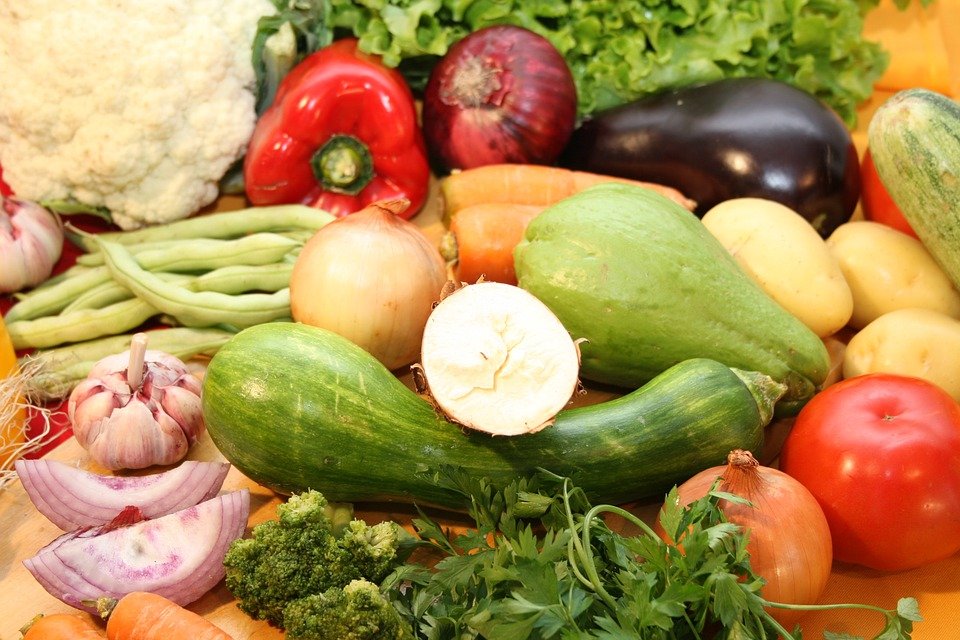
SMALLHOLDER farmers at Cashel Valley and Nyanyadzi irrigation schemes – which have a combined 1 000 hectares – have landed a lucrative deal to grow a wide range of horticulture products for the Arab, Mozambican and South African markets.
The Livelihoods and Export Aided Programme (LEAP) and Community Based Health Financing (CBHF) are aimed at complementing initiatives being implemented to achieve Vision 2030 as well the Sustainable Development Goals (SDGs) through poverty alleviation and inclusive economic growth.
The deal – being piloted by Africa Economic Development Strategies (AEDS), Durban University of Technology (DUT) and CareNet Africa (CNA) – is market driven and being run on a commercial basis to ensure sustainability and high returns for farmers
The consortium has injected US$50 000 into the project which started with 81 farmers who are producing gonions.
Next week another batch of 100 farmers will embark on butternut production.
AEDS executive director, Professor Gift Mugano said Cashel Valley (500ha) and Nyanyadzi (480ha) are being funded to produce high quality horticulture products like onions, butternuts, tomatoes, cucumbers and watermelons.
Under the programme, farmers are entitled to critical components for production like funding, marketing, information, inputs and health support.
DUT will come in with the thrust of entrepreneurship and training on wellness, while CareNet Africa under Masawara Holdings will cater for farmers’ medical needs following the realisation that most of them lack access to primary health care.
Prof Mugano said a donor conference is scheduled for November 25 to mobilise US$30 million to expand the project in Zimbabwe and South Africa for the next three years.
Cashel Valley and Nyanyadzi irrigation schemes used to supply big companies in Mutare and Harare, but their capacity took a huge knock due to side marketing and exploitation of farmers.
Before rolling out the project, the consortium conducted a three months exercise to understand the challenges on the ground.
“Our product offering is informed by an understanding of the circumstances on the ground. We have understood the need for consensus and ownership of the project by the community for it to be sustainable.
“The farmers are in charge of the programme and have put their own governance structures. We gave them ownership, it is their programme. Even in pricing, we do research together, but we will also take on board some companies that were there before us.
“You need transparency, accountability and consensus,” said Prof Mugano.
The farmers are anticipating a yield of 240 tonnes of onions in 90 days, which will translate to US$120 000 at US$0.50 per kilogramme.
“This is a game changer as we are making the markets work for the poor. We have big retail shops that have agreed to take our first produce. We are also working with seed houses who will be on the ground giving demonstrations to farmers.
“Our vision is to feed the Arab Club. If we get donor support we will be intensive and concentrate on the two schemes before looking elsewhere for good water and organised land.
“We are building resilience in the communities because they will be paid in foreign currency and create employment. As we grow bigger, we should actually create more jobs and make it an enterprise. We are also building a health base in the communities. We do not want people to succumb to ailments that can be dealt with,” said Prof Mugano.
He added: “We need to be certain about the quality of products our farmers can produce and when we have that practical evidence, take the next crop to the foreign market. We do not want our containers to be rejected when they are in Dubai. Once we are satisfied that the produce meets international standards, we will ship the next produce to foreign markets,” said Prof Mugano.
Mr Sam Sithole, who is the chairman for the Nyanyadzi project, said the consortium is helping them with both extension services, inputs and medical aid.
“We could not do all these things on our own due to the economic challenges. About 70 percent of the farmers had resigned to fate and this is a huge opportunity that has been embraced by everyone.
“Small-holder farmers do not have medical aid and therefore getting medication and drugs has been a challenge. We are guarding the investment jealously and have put in place security, governance and operation structures to protect the crop. The project speaks to our aspirations as rural people,” said Mr Sithole.

Zimbabwe imported agricultural products worth more than US$1bn, half of its maize last year (2019), despite investing more than US$3bn in “command agriculture”, a controversial programme to ensure food self-sufficiency introduced in 2016. AEDS launched the second Annual Zimbabwe Agricultural Survey Report 2019-2020 which suggests that agriculture should be run on a free- market system and the government should create an enabling system just like in tobacco which is the only success story in Zimbabwe Agriculture Sector.
AEDS executive director Prof Gift Mugano, said that command agriculture is registering a low uptake because the government is interfering in maize production. The leading researcher, Prof G Mugano revealed that, the price of maize is gazetted by the minister of finance and the sole buyer, Grain Marketing Board (GMB), takes long to pay farmers at the end. Even with subsidies farmers run losses, that’s why farmers are now avoiding this area.
The Annual Agriculture Sector Survey by AEDS report notes that in 2019 there was a huge decrease in the production of maize, the staple crop whose major contributor to the national output is mainly smallholder farmers and peasants. One striking observation from the 2019 maize yield is that on average, maize yield per hectare declined by about 54%. More than 7.5 million Zimbabweans in urban and rural communities require food aid, according to the UN fact sheet. Zimbabwe requires 100,000 tonnes of maize per month and most of that comes from SA. As such, food inflation in SA has a direct effect on Zimbabweans and their access to food at affordable prices.

The 2nd Edition Zimbabwe Agriculture sector survey report, argues that despite climate change and other natural disasters such as drought, government policy contributes to the man-made negative effects of agricultural output. Over and above the effects of climate change and economic hardships, policy in a way significantly contributes to poor output in the agricultural sector. Production of crops such as wheat and soya beans remain low because of price controls, since the government set prices on these commodities. However, there has been an increase in cash crop production because of private sector support. For the production of cash crops such as tea, macadamia, sugar cane and tobacco, the study noted that there has been progressive growth in the production of these crops because they are largely funded by the private sector through contract farming, though farmers lack collateral security.
Since the turn of the century, at the beginning of chaotic land reforms, the government had embarked on various initiatives to mechanise new farmers. However, the Reserve Bank of Zimbabwe’s quasi-fiscal approach to agriculture and, most recently, command agriculture, benefited the ruling elite. Hence, according to the 2ND Edition Zimbabwe Agriculture Sector Survey 2019-202, the country has huge deficits in tractors (30,000), combine harvesters (400), rippers (13,800), disc harrows (8,000), planters (17,800), spreaders (4,500), boom sprayers (4,000) and shellers (14,500).
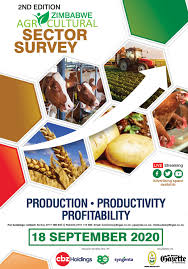
Zimbabwe Agriculture Society, SEEDCO, CBZ and Fingaz in partnership with Africa Economic Development Strategies presents the 2ND Edition of Zimbabwe Agriculture Sector Survey (2019-2020).

In Zimbabwe Prices of basic commodities have stabilised over the last two months, attributing the development to mediations introduced by government to quell financial indiscipline and rent-seeking behaviour. The measures include the establishment of a foreign currency auction system in June, which has seen Zimbabwe enjoy relative stability. Other measures include tighter control on mobile money platforms, which were being used to facilitate foreign currency trading on the black market.as a result, prices of essentials/ basics such as cooking oil, sugar, rice and bread in most retail outlets, which had been volatile since the reintroduction of the local unit, have stabilised. Correspondingly, production is on the up.
AEDS Executive Director the leading economist in Zimbabwe Professor Gift Mugano is calling on government to further refine its policies to stimulate production and ensure long term price stability. Government recently introduced the “PFUMVUDZA PROGRAMME” in agriculture, which is a very noble programme. If articulated well, the programme will indeed ramp up production in the agriculture sector, for instance, production of soyabean means an increase in the production of cooking oil, production of cereals and this will save a lot of foreign currency. This will lead to the right pricing regime and availability of the product and stop foreign currency leakages. We need aggressive manufacturing and industrial policies that will see production of goods at a large scale and ultimately lead to exports.
We need to support the productive sector and have in place production policies that stimulate manufacturing. This will help with price stabilisation and product availability in the long run.
Dialogue, 09/18/20 @ Meikles Hotel 07.00 Hrs
THE second annual Zimbabwe Agricultural Survey, hosted by the AEDS in partnership with ZAS & Financial Gazette with support from CBZ, will be launched on 18 September 2020, with speakers highlighting the importance of the study as Zimbabwe enters its agricultural season on the back of two successive droughts and a disruptive global pandemic.The event will be running under the theme Production. Productivity. Profitability, this year’s survey was meant to produce findings that will serve as a mechanism to identify and prioritise Zimbabwe agricultural improvement areas and provide a benchmark upon which future improvements in the sector will be measured.