
Zimbabwe’s banking sector has expanded its loan book, with total loans and advances reaching ZiG94.61 billion by June 2026, compared with ZiG67.51 billion recorded in June 2025, latest data shows.
The increase points to stronger demand for credit as businesses seek funding to maintain operations, finance new investments and increase production.
According to the 2026 Mid-Term Monetary Policy Statement, foreign currency lending continues to dominate the market.
US dollar -denominated loans accounted for 90.2% of total bank lending at the end of June, reflecting the continued reliance of Zimbabwean businesses on hard currency.
A large share of the money borrowed from banks went into areas directly linked to economic production.
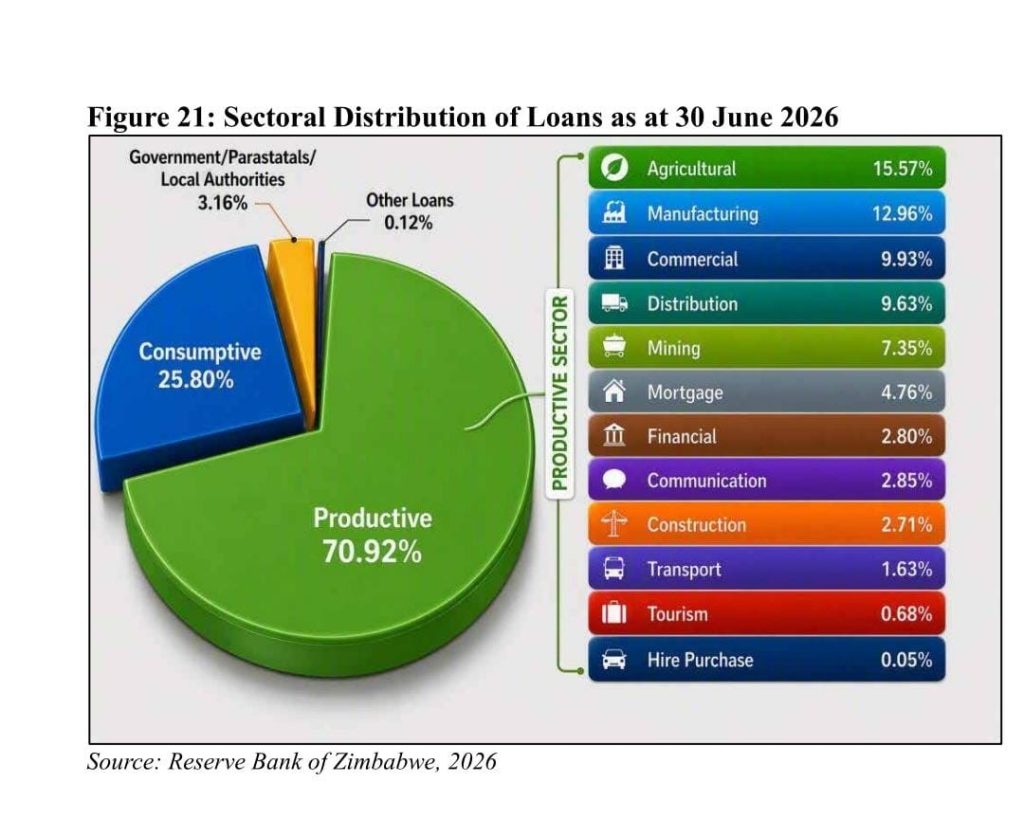
According to the Reserve Bank of Zimbabwe, productive sectors accounted for 70.92% of total bank lending during the period under review.
Agriculture received the largest portion at 15.57%, followed by manufacturing with 12.96%. Commercial activities accounted for 9.93%, while distribution received 9.63%.
Mining companies also remained important borrowers, taking 7.35% of total bank credit. The figure highlights the sector’s continued demand for funding to support production, equipment purchases and other operational requirements.
Other sectors recorded smaller portions of the banking sector’s loan portfolio. Mortgages accounted for 4.76%, communication 2.85%, financial services 2.80% and construction 2.71%. Transport received 1.63%, while tourism took 0.68%.
Despite the strong allocation towards productive activities, consumer lending remained sizeable at 25.80% of total loans.
Government, parastatals and local authorities accounted for 3.16% of lending, while other loans made up 0.12%.
The credit growth comes at a time when Zimbabwe is seeking to strengthen local production and encourage investment across the economy.
For businesses, access to bank finance can provide the cash needed to buy raw materials, upgrade machinery, expand operations and meet short-term expenses.
The latest figures show that banks are becoming an increasingly important source of financing for the productive economy, with agriculture, manufacturing, commerce and mining taking a substantial share of available credit.