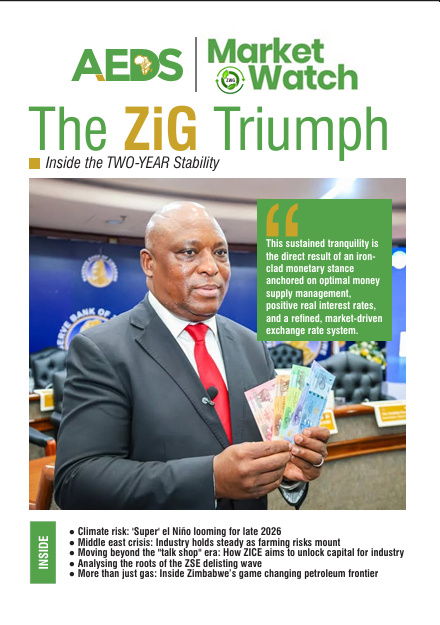
The Reserve Bank has implemented bold monetary policy measures to foster price, currency and exchange rate stability geared towards containing inflationary and exchange rate pressures since 2024.
Precisely, the Reserve Bank has walked the talk through implementing a prudent monetary policy stance anchored on optimal money supply management, maintaining positive real interest rates, ensuring a floating exchange rate system and robust accumulation of foreign currency reserves to back the ZiG currency.
The following are the key drivers supporting the current sustained stability in the economy:
- Prudent money supply management with reserve money growth calibrated to support the envisaged growth of 6.6% and a disinflation program expected to bring inflation to low and sustainable levels.
- Effective liquidity management aimed at supporting growth of the productive sectors while curbing speculation on the local currency.
- Maintenance of positive real interest rates which has curbed speculative borrowing while supporting productive borrowing and fostering a savings culture. This was buttressed by the prudent utilisation of an inflation neutral Targeted Finance Facility (TFF) for productive sectors.
- Coordination and complementarity between the Reserve Bank and Ministry of Finance at all levels including Liquidity and Cash Flow Management Committees has allowed synchronicity of payments and support of optimal liquidity management.
- Refined floating exchange rate based on a Willing Buyer Willing Seller (WBWS) framework which has been supported by removal of trading limits and clarifications on trading margins.
- The smooth functioning of the interbank market has also benefited from increased foreign currency receipts, which amounted to US$16.2 billion between January and December 2025.
- The increased foreign currency inflows allowed the Reserve Bank to effectively use surrender requirements to strategically intervene on the interbank market to the tune of US$1.34 billion since April 2024. This ensured that all bonafide import invoices have been met.
- Accumulation of foreign reserves to about US$1.2 billion, which corresponds to 1.5 months of import cover resulting in increased confidence in local currency and stability of the exchange rate.
- The increased foreign currency reserves have increased the cover for reserve money and broad money to about 6- and 2-times cover, respectively.
- Furthermore, the non-recourse to Central Bank financing by Treasury in 2025 has been key in underpinning the obtaining sustained stability.
- The above measures have been key in reducing annual ZiG inflation, which fell to 15% in December 2025.
- Importantly, the decline in inflation also resulted in a stable exchange rate with the parallel market premium contained to around 20% for the greater part of 2025.
- Overall, the Reserve Bank’s commitment to prudent monetary policy and walking the talk has supported greater confidence in local currency. The predictability in the monetary policy assisted in improving central bank trust and credibility which has enhanced public confidence in the Reserve Bank.
- Going forward, the Reserve Bank will continue to walk the talk in implementing prudent monetary policy to durably anchor inflation expectations needed to entrench trust, confidence and credibility in the Bank.